SaaS CFO Services
SaaS CFO Services. Metrics That Survive Diligence.
ARR, retention, and unit economics defined once, reconciled to the ledger, and reported consistently. For subscription businesses whose board numbers and accounting numbers have quietly drifted apart.
Quick Answer
What are SaaS CFO services?
SaaS CFO services provide part-time senior financial leadership built for subscription businesses. The work covers ARR and retention reporting, unit economics such as CAC payback and LTV to CAC, ASC 606 revenue recognition and deferred revenue, cash runway and burn multiple, and investor reporting. Fractional engagements typically cost $4,000 to $12,000 per month in the U.S.
Key Takeaways
- In subscription models, cash and recognised revenue are permanently out of step.
- Most SaaS reporting problems are definition problems, not bookkeeping problems.
- Investors test ARR bridges, cohorted retention, CAC payback, and burn multiple.
- The usual trigger is a priced round or an acquirer, typically between $1M and $10M ARR.
Last reviewed by Michael Minnaugh, Founder & CEO, and the Sataurius advisory team.
Why SaaS Finance Breaks Differently
In a subscription business, cash and revenue are permanently out of step. An annual contract collected upfront looks like a strong month and a weak balance sheet at the same time. Growth consumes cash before it produces it. And a metric as apparently simple as ARR can be calculated four different ways inside the same company.
The consequence is that SaaS companies often have accurate bookkeeping and unreliable management reporting. The general ledger is correct; the numbers the board is looking at are not derived from it consistently.
The Metrics We Own
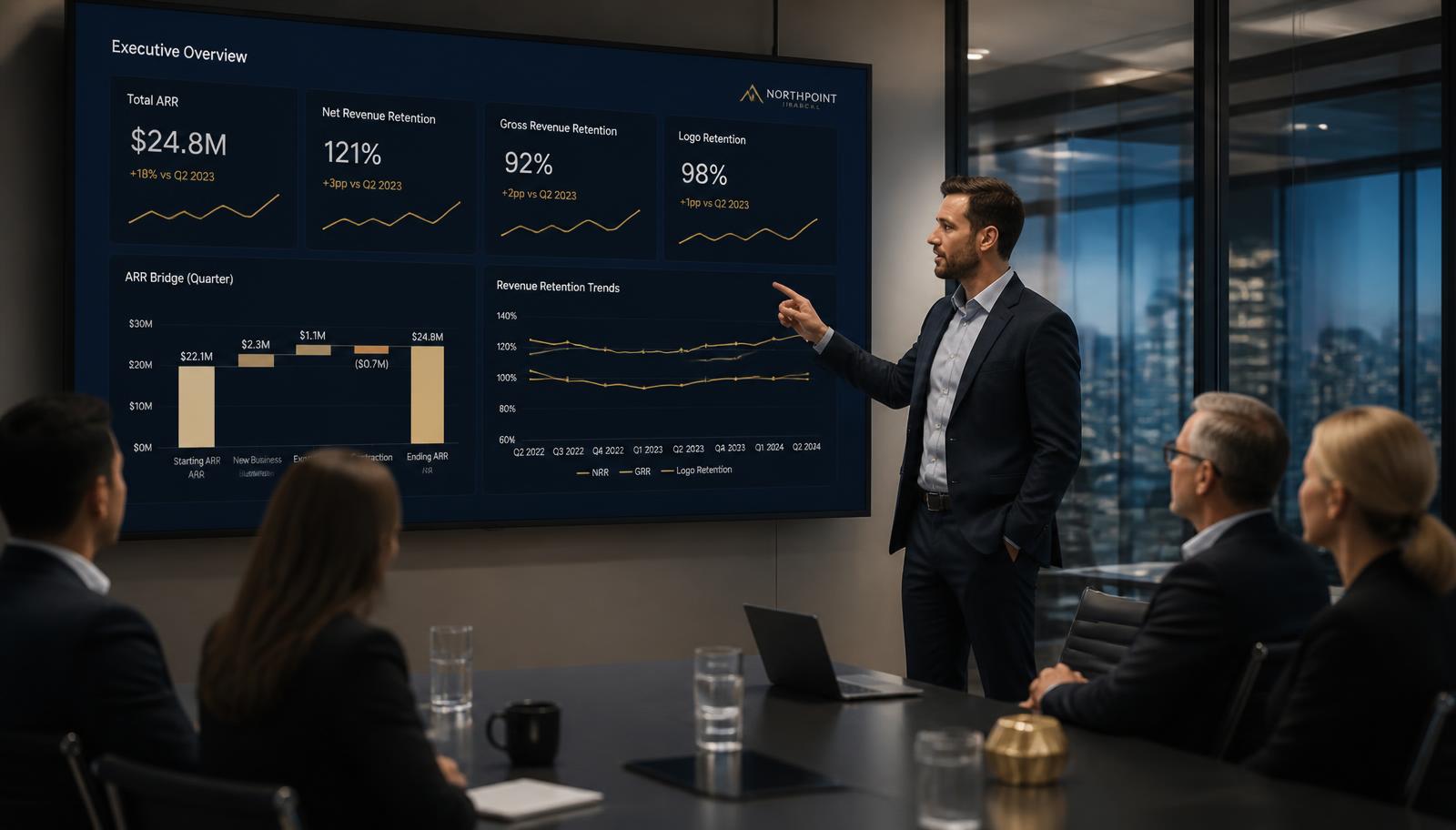
- ARR bridge: starting ARR, new, expansion, contraction, churn, ending ARR, with definitions documented and held constant.
- Retention: net and gross revenue retention, plus logo retention, cohorted rather than blended.
- Unit economics: CAC payback in months, LTV to CAC, and gross margin after hosting, support, and customer success.
- Efficiency and runway: burn multiple, months of runway, and the sensitivity of both to hiring plans.
- Revenue recognition: ASC 606 treatment, deferred revenue schedules, and contract-level review of non-standard terms.
How the Engagement Works
We start by rebuilding the metric definitions from the contract and billing data rather than inheriting the existing spreadsheet, then reconcile them back to the general ledger. Once the definitions hold, the monthly reporting cadence and the board pack are built on top of them.
From there the work is ordinary CFO work applied to a subscription model: board reporting, cash forecasting, hiring plan modelling, and fundraise or transaction support. The broader offering sits on our fractional CFO services page, and where the close itself is unreliable we start with controller-level support instead.
What's Included
Scope of Engagement
ARR and Retention Reporting
A documented ARR bridge and cohorted net and gross retention, reconciled to the general ledger every month.
Unit Economics
CAC payback, LTV to CAC, and true gross margin after hosting, support, and customer success costs.
ASC 606 Revenue Recognition
Deferred revenue schedules and contract-level treatment for multi-year, usage, and implementation revenue.
Cash Runway and Burn
Rolling runway, burn multiple, and scenario models tied directly to the hiring and go-to-market plan.
Investor and Board Reporting
A standing pack with consistent definitions, so period-on-period comparison is trivial and defensible.
Fundraise and Diligence Support
Operating model, data room, metric reconciliation, and management support through investor diligence.
FAQ
Frequently Asked Questions
What are SaaS CFO services?
SaaS CFO services provide part-time senior financial leadership tailored to subscription businesses. The work centres on ARR and retention reporting, unit economics such as CAC payback and LTV to CAC, cash runway and burn multiple, ASC 606 revenue recognition, deferred revenue, and investor and board reporting.
What metrics should a SaaS company report to investors?
ARR with a bridge showing new, expansion, contraction, and churn; net and gross revenue retention; gross margin after hosting and support costs; CAC payback in months; LTV to CAC; burn multiple; runway; and magic number or an equivalent efficiency measure. Investors care as much about the consistency of the definitions as the values themselves.
How is SaaS revenue recognition different?
Under ASC 606, subscription revenue is recognised over the service period rather than when invoiced, which creates deferred revenue and separates cash collected from revenue earned. Multi-year contracts, usage overages, implementation fees, and discounts each need explicit treatment. Getting this wrong is one of the most common findings in a SaaS diligence process.
When does a SaaS company need a CFO?
Usually somewhere between $1M and $10M in ARR, or earlier if a priced round is imminent. The trigger is not size but scrutiny: the first time an investor, board, or acquirer will test your numbers, the definitions behind them need to be defensible and consistent with prior reporting.
How much do fractional SaaS CFO services cost?
Fractional CFO engagements for SaaS companies typically run $4,000 to $12,000 per month depending on reporting cadence, fundraising activity, and complexity of the revenue model. A full-time SaaS CFO generally costs $250,000 to $400,000 fully loaded before equity.
Can you support a fundraise or an acquisition?
Yes. That includes building the operating model and scenario cases, assembling the data room, defining and reconciling the metrics investors will diligence, preparing the historical financials, and supporting management through diligence questions and negotiation.
Related
Continue Exploring
Fractional CFO Services
The full outsourced CFO offering across industries, including engagement models and cost.
Learn More →Board Reporting
Board packs built around the decisions your directors and investors actually make.
Learn More →Technology & ERP Implementation
Billing, revenue, and finance systems architecture for subscription businesses.
Learn More →Part of Fractional CFO Services. Also see: Interim CFO Services, CFO Services for Small Business, Fractional CFO Cost.